Postdoc in Applying Generative Artificial Intelligence in Chemical Engineering Education - DTU Chemical Engineering
Danmarks Tekniske Universitet

If you are passionate about cutting‑edge research in bioprocess modelling and eager to shape the next generation of digital twins for industrial biomanufacturing, we invite you to join us.
At DTU Chemical and Biochemical Engineering, you will operate at the forefront of computational modelling, integrating high‑fidelity CFD with advanced compartment models and modern data‑driven methods to decode the physics, chemistry, and biology of complex multiphase bioreactors. Working within PROSYS, you will have the freedom to design rigorous simulation campaigns, develop reduced‑order models that preserve essential transport and reaction phenomena, and fuse these with metabolic modelling to create scalable, verifiable digital twins. Your contributions will span from building automated CFD workflows and Lagrangian particle/cell tracking to extracting actionable insights with statistical learning and AI/ML—ultimately enabling more robust scale‑up, smarter process control, and faster innovation in bio‑based production.
We are seeking a highly motivated postdoctoral researcher who brings both scientific curiosity and engineering pragmatism, with a strong profile in bioprocess modelling.
The postdoc position is part of the MOREGAS Challenge project, which aims to investigate the use of advanced model-based approaches toward improved operation of gas fermentation systems.
Responsibilities
Your overall focus will be to develop next-generation digital models and digital twins for complex bioprocesses, combining high-fidelity CFD of single- and multiphase bioreactors with advanced metabolic and statistical models. You will work closely together with nearby colleagues as well as academic and industrial partners in Denmark and abroad.
Required qualifications:
We are looking for a candidate with a strong profile in bioprocess modelling, CFD, and data-driven methods, and with several of the following qualifications:
- CFD for bioreactors
- Documented experience with CFD for bioreactors (single and multiphase), using ANSYS Fluent, CFX, OpenFOAM or similar tools.
- Experience implementing advanced user-defined functions (UDFs) for reaction kinetics, rheology, and multiphase interactions.
- Automation, HPC and software skills
- Proven experience with CFD automation, e.g. using PyFluent or similar Python APIs for meshing, solver control, post-processing and data management.
- Solid experience programming in Python (for automation, data analysis and ML) and C/C++ (for UDF development and high-performance routines).
- Hands-on experience running large simulation campaigns in an HPC environment (job schedulers, batch scripts, profiling, basic performance optimisation).
- Experience with CAD tools and CAD automation (e.g. parametric geometry definition and scripting).
- Compartment and metabolic modelling
- Experience working with compartment models for bioreactors and/or developing reduced-order models to complement CFD simulations.
- Experience with metabolic modelling, such as GEMs, pool models, or constraint-based models (e.g. using COBRApy or related toolboxes), or a strong motivation to develop this expertise.
- Data science, AI/ML, and digital surrogate models
- Experience with data science and machine learning, including having developed AI/ML models in open-source frameworks such as PyTorch, TensorFlow or scikit-learn.
- (Preferred) Experience using CFD-derived datasets to build surrogate models for bioreactors.
- Academic background
- PhD in bioprocess modelling, chemical/biochemical engineering, computational modelling, or a closely related field (or ready to be defended in the following months).
- A track record of high-quality research, as documented by publications in relevant international journals and conferences.
Your primary tasks will be to:
Your primary tasks will be to:
- Develop advanced compartment models for multiphase bioreactors, informed and validated by CFD simulations.
- Implement and analyse Lagrangian tracking of cells and particles in the reactor to quantify heterogeneity in exposure histories.
- Perform statistical and data-driven analysis of the large datasets generated by CFD, Lagrangian tracking and metabolic simulations.
- Develop and integrate a modelling platform that couples metabolic models (e.g. GEMs, pool models) with compartment and CFD-based models, enabling digital twins of industrial bioprocesses.
- Contribute to building automated, reproducible modelling pipelines (CFD → compartment model → metabolic model → surrogate/digital twin).
- Combine compartment models with Lagrangian tracking of particles.
As part of your activities, you are expected to:
- Conduct excellent research in several of the above-mentioned research fields.
- Disseminate your research through scientific publications, international conferences and workshops, and, where relevant, open-source software.
- Apply for and help lead innovative projects, including both national and international collaborations.
- Establish and maintain collaborations with partners within and outside DTU, including industrial partners in the bioprocess and biotech sectors.
- Teach and supervise BSc and MSc student projects and co-supervise PhD students, particularly in areas such as CFD for bioprocesses, digital twins, metabolic modelling, and data-driven methods.
We offer
DTU is a leading technical university globally recognized for the excellence of its research, education, innovation and scientific advice. We offer a rewarding and challenging job in an international environment. We strive for academic excellence in an environment characterized by collegial respect and academic freedom tempered by responsibility.
Salary and terms of employment
The appointment will be based on the collective agreement with the Danish Confederation of Professional Associations. The allowance will be agreed upon with the relevant union.
The period of employment is 3 years. Starting date is 1 March 2026 or as soon as possible according to mutual agreement. The position is a full-time position.
You can read more about career paths at DTU here.
Further information
Further information may be obtained from Ulrich Kruhne, email: [email protected].
You can read more about the DTU Chemical Engineering at www.kt.dtu.dk.
If you are applying from abroad, you may find useful information on working in Denmark and at DTU at DTU – Moving to Denmark.
Application procedure
Your complete online application must be submitted no later than 26 January (23:59 Danish time). Applications must be submitted as one PDF file containing all materials to be given consideration. To apply, please open the link "Apply now", fill out the online application form, and attach all your materials in English in one PDF file. The file must include:
- Application (cover letter)
- CV
- Academic Diplomas (MSc/PhD – in English)
- List of publications
Applications received after the deadline will not be considered.
All interested candidates irrespective of age, gender, disability, race, religion or ethnic background are encouraged to apply. As DTU works with research in critical technology, which is subject to special rules for security and export control, open-source background checks may be conducted on qualified candidates for the position.
DTU Chemical and Biochemical Engineering
At the Department of Chemical and Biochemical Engineering our research is built on the technological core subjects and engineering scientific disciplines. Our research covers separation processes, reaction engineering, dynamics and process regulations, process and facility planning, unit operations, heat transmission, fluid mechanics and applied thermodynamics. We work closely with industry to obtain research results that are applicable to industry and society. Within our research centres we carry out a wide range of specialized chemical and biochemical engineering research through field experiments, experiments in lab scale, pilot facilities and in industrial scale. Our main activities are in the areas of product design, process design and production in the chemical, biotechnological, pharmaceutical, food – and energy technological industries.
PROSYS, Process and System Engineering Center
Our main purpose is to perform research and provide education that will contribute to advancing technologies for future more sustainable (Bio)chemical production processes. Furthermore, our activities include digitalization of production processes. We also address societal challenges, mainly contributing to a few Sustainable Development Goals (SDGs), most importantly sustainable production and consumption (SDG12), climate action (SDG13) and affordable and clean energy (SDG7).
Technology for people
DTU develops technology for people. With our international elite research and study programmes, we are helping to create a better world and to solve the global challenges formulated in the UN’s 17 Sustainable Development Goals. Hans Christian Ørsted founded DTU in 1829 with a clear mission to develop and create value using science and engineering to benefit society. That mission lives on today. DTU has 13,500 students and 6,000 employees. We work in an international atmosphere and have an inclusive, evolving, and informal working environment. DTU has campuses in all parts of Denmark and in Greenland, and we collaborate with the best universities around the world.
Location
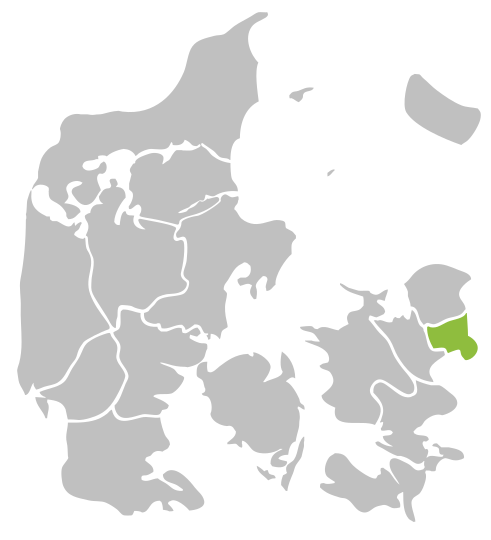
Kgs. Lyngby, Denmark
Apply Before
2026-01-26T22:59:00+00:00
Opslaget er indhentet automatisk fra virksomhedens jobsider og vises derfor kun som uddrag. Log ind for at se det fulde opslag eller gå videre til opslaget her: