Postdoctoral Researcher in Automated Microbial Phenotyping and Predictive Assay Development - DTU Bioengineering
Danmarks Tekniske Universitet

Shape the future of sustainable agriculture! Join DTU Bioengineering and the global Initiative for Biofertilizer Innovation and Science (IBIS) to develop next-generation microbial biofertilizers through cutting-edge high-throughput research and innovation in a world-class collaborative environment.
This two-year postdoctoral position offers a unique opportunity to contribute to one of the world's largest open-science initiatives dedicated to advancing microbial biosolutions for sustainable agriculture. As part of an international consortium of leading research institutions, you will help develop the scientific knowledge, technologies, and research infrastructure needed to accelerate the discovery and deployment of next-generation microbial biofertilizers.
IBIS is a five-year global open-science initiative supported by 210 million DKK (approximately 30 million USD) in combined funding from the Gates Foundation and the Novo Nordisk Foundation. Coordinated by DTU, the consortium brings together leading partners across Europe, South Asia, and Sub-Saharan Africa to establish an open Biosolutions Development Pipeline spanning microbial discovery, characterization, fermentation, formulation, in planta performance, and field evaluation. The initiative aims to advance the fundamental understanding of effective microbial biofertilizers while developing the technologies, predictive models, and standardized research framework needed to accelerate their development and deployment.
DTU leads the laboratory phase of the pipeline using advanced robotic workflows and high-throughput technologies, while partner institutions conduct field trials and upscaling across diverse agricultural environments in the Global North and South. By generating harmonized, large-scale datasets across the R&D pipeline, IBIS promotes reproducible, collaborative, and open research while enabling data-driven discovery and predictive BioAg development.
About the role
As part of the IBIS consortium, you will join the High-Throughput & Automation team and play a key role in developing robotics-assisted high-throughput microbial phenotyping assays that generate biologically meaningful, quantitative, and predictive data for screening and characterizing microbial biosolutions. Working at the interface of microbiology, automation, and data science, you will identify microbial traits associated with manufacturability, formulation robustness, fermentation performance, and field performance. These data will provide the foundation for predictive models and data-driven strain advancement across the IBIS Biosolutions Development Pipeline.
A key aspect of the role is designing assays with the end application in mind, not only to measure microbial function, but also to generate robust, reproducible, and structured datasets that can be translated into scalable, robotics-assisted high-throughput workflows for predictive phenotyping and informed strain selection.
Your responsibilities:
- Design, develop, validate, and optimize automated high-throughput microbial phenotyping assays for bacterial and fungal biofertilizer strains.
- Identify and quantify microbial functional traits that are predictive of strain performance.
- Optimize and translate phenotyping assays into robotics-assisted high-throughput workflows to generate standardized, traceable, and high-quality biological datasets.
- Generate, analyze, and interpret phenotypic data sets to identify informative features that support predictive models and data-driven strain selection.
- Evaluate and refine assay performance using statistical analysis and predictive model feedback to improve robustness, reproducibility, and throughput.
- Develop SOPs, validation criteria, and documentation to ensure reproducibility and long-term platform utility.
- Collaborate with microbiologists, fermentation scientists, automation specialists, and data scientists to integrate predictive phenotyping workflows into the IBIS Biosolutions Development Pipeline.
- Contribute to scientific publications, student supervision, teaching activities, and dissemination of research results.
Your profile
- PhD in microbiology, biotechnology, microbial ecology, bioengineering, industrial microbiology, analytical chemistry, analytical sciences, or a related field.
- Experience developing, optimizing, and validating biological or microbial assays.
- Strong understanding of experimental design, controls, reproducibility, and assay validation.
- Experience with microbial strain phenotyping or functional screening.
- Understanding of microbial biology to develop biologically meaningful assays and interpret phenotypic data.
- Experience analyzing biological datasets using quantitative and data-driven approaches to guide assay development and strain selection
- Good Python programming skills for data analysis and scripting, with the ability to learn and adapt laboratory automation workflows.
You will thrive in this role if:
- You thrive in an interdisciplinary and international research environment, collaborating across microbiology, automation, and data science to solve complex biological challenges.
- You can work independently while contributing actively to collaborative research across an international consortium.
- You are curious, proactive, and enjoy developing new technologies and continuously improving experimental workflows.
Preferred qualifications
- Experience with automated high-throughput microbial screening or laboratory automation platforms (e.g., Tecan, Hamilton, Opentrons).
- Experience with large-scale biological datasets; familiarity with predictive modeling or machine learning is an advantage.
As a formal qualification, you must hold a PhD degree (or equivalent).
We offer
DTU is a leading technical university globally recognized for the excellence of its research, education, innovation and scientific advice. We offer a rewarding and challenging job in an international environment. We strive for academic excellence in an environment characterized by collegial respect and academic freedom tempered by responsibility.
Salary and terms of employment
The appointment will be based on the collective agreement with the Danish Confederation of Professional Associations. In addition, supplements can be negotiated in accordance with DTU’s salary structure for scientific staff: www.inside.dtu.dk/en/human-resources/during-employment/salary/salary-structures.
The period of employment is 2 years. Start date is December 1, 2026, or soonest thereafter. The position is a full-time position.
You can read more about career paths at DTU here.
Further information
For further information, please visit our website, ibis.dtu.dk, or contact Attn: Meilee Ling ([email protected]).
You can read more about DTU Bioengineering at www.bioengineering.dtu.dk
If you are applying from abroad, you may find useful information on working in Denmark and at DTU at DTU – Moving to Denmark.
Application procedure
Your complete online application must be submitted no later than 14 August 2026 (23:59 Danish time).
Applications must be submitted as one PDF file containing all materials to be given consideration. To apply, please open the link "Apply now", fill out the online application form, and attach all your materials in English in one PDF file. The file must include:
- Application (cover letter) - max 1 page
- CV – max 2 pages
- Academic Diplomas (MSc/PhD – in English)
- List of publications - max 1 page
- One publication (published in peer-review) - Your most relevant paper for IBIS
Upload the combined PDF file under the cover letter option in the DTU application system.
Applications received after the deadline will not be considered.
All interested candidates irrespective of age, gender, disability, race, religion or ethnic background are encouraged to apply. As DTU works with research in critical technology, which is subject to special rules for security and export control, open-source background checks may be conducted on qualified candidates for the position.
The Department of Biotechnology and Biomedicine (DTU Bioengineering) is an international leader in the areas of biotechnology and biomedicine. Our engineering approach to all aspects of biotechnology and biomedicine positions us as a valuable player with unique competences in a growing bio-based economy and with health systems transforming towards personalized medicine. We have a clear focus on the needs in the life science- and biotech industries and point towards innovation, new businesses, and scientific services for the benefit of society. The department has extensive collaborations with national and international research units and industry. DTU Bioengineering has approx. 400 employees, of which 2/3 are scientific staff. The department is located at DTU Lyngby Campus.
DTU – For the benefit of society since 1829
DTU is one of Europe's leading elite technical universities. Through research and education at an international top level, we create solutions to the major societal challenges of our time and help secure Europe's global leadership in sustainable technological development. Since Hans Christian Ørsted founded DTU almost 200 years ago, our mission has remained the same: We develop and create value through the natural and technical sciences for the benefit of society. DTU has 13,800 students, 1,600 PhD students, and 6,500 employees. We work in an international environment and have an inclusive, stimulating, and informal work culture. DTU has campuses in all parts of Denmark and in Greenland and collaborates with the best universities around the world.
Location
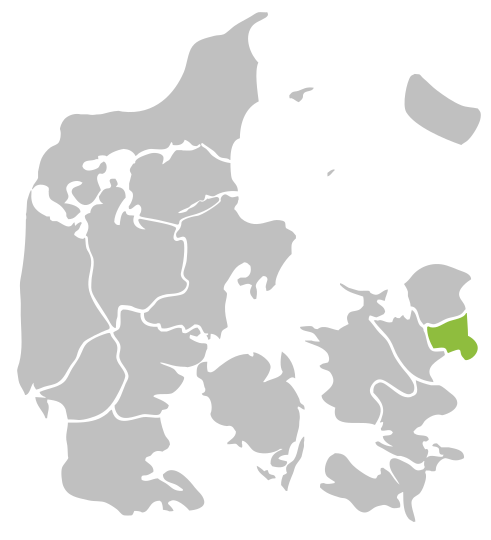
Kgs. Lyngby, Denmark
Apply Before
2026-08-14T21:59:00+00:00
Opslaget er indhentet automatisk fra virksomhedens jobsider og vises derfor kun som uddrag. Log ind for at se det fulde opslag eller gå videre til opslaget her: