PhD position(s) at the Digital Democracy Centre
Syddansk Universitet (University of Southern Denmark - SDU)

The Digital Democracy Centre (DDC) at the University of Southern Denmark, Odense, invites applications for one or more full-time PhD positions as part of the interdisciplinary research project AI in the News Ecosystem: Navigating Trust and Authenticity (AINATA).
The AINATA project explores how artificial intelligence (AI) impacts trust and authenticity in the news ecosystem. It investigates how AI affects both news production and consumption and assesses the adequacy of existing legal frameworks in addressing these transformations.
Read more about the project HERE.
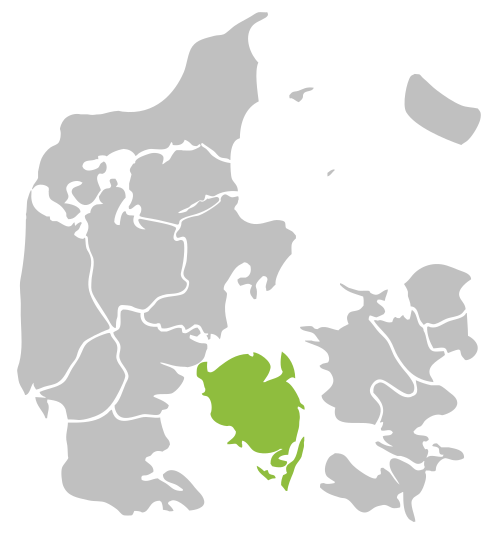
Employment can be from June 2026 or later in 2026 by agreement. The place of employment will be in Odense.
Research profiles and tasks
We are looking for different candidates with a background in either communication, journalism, political science, sociology, law, economics, or computational social science, as well as an interest in how AI transforms the media and information ecosystem. The PhD student(s) will be embedded in an interdisciplinary project team and collaborate closely with other scholars at the Centre
Specifically, we are looking for candidates interested in one of the following research profiles. Applicants should indicate in their application which profile (1-4) they wish to be considered for.
Profile 1: Communication Science / Political Science / Economics
Research includes platform experiments testing how citizens interact with AI-generated news content and effectiveness of transparency measures
Profile 2: Communication Science / Media Effects / Sociology
Research includes surveys on citizens’ attitudes toward AI in news and audience research on perceptions of authenticity and trust.
Profile 3: Communication Science / Computational Social Science / Sociology
Research includes social network analyses to map the news influencer ecosystem and interviews with news influencers.
Profile 4: Law / Digital Media Regulation
Research includes analyses of EU regulatory frameworks on AI and media and evaluating transparency and accountability obligations in news and influencer contexts
Expectations and key responsibilities
The PhD student(s) will be involved in all aspects of the research, from conception, execution, analysis, publishing, and public dissemination. A solid set of field specific methods is necessary.
Candidates are expected to be willing and able to contribute to the DDC by producing original research of high international quality, engage in exchange of knowledge with relevant societal actors, including news media, the public, and policymakers, be part of grant acquisition and impact activities, and contribute to team building and the development of the centre.
Candidates are expected to:
- Be capable of working independently and in a team, for example in data collection, writing scientific articles, and knowledge dissemination
- Contribute both academically and socially to the research environment at the DDC
- Be able to communicate project results in English both in writing and orally in academic contexts and to the broader public (Danish is an advantage but not required)
- Present research results at international conferences
- Possibly contribute to teaching programs (in consultation with relevant departments)
- Work and be present at the Centre in Odense
If you already have a PhD degree, please note that we are also recruiting postdocs with similar research interests for the project. See SDU’s current vacancies for more information.
Inquiries about the project and the positions can be addressed to the Centre Director, Prof. Claes Holger de Vreese ([email protected]).
About the DDC
The DDC is a part of the Faculty of Business and Social Sciences. It is an interdisciplinary Centre with members from computer science, law, media studies, political science, business, and organizations. The DDC believes in fostering a stimulating and inspiring environment for both faculty members and students. The DDC’s ambition is to recruit, develop, and retain talented scholars committed to both research, education, and impact. Furthermore, the DDC wishes our staff to reflect the diversity of society and thus welcomes applications from all qualified candidates regardless of personal background.
You can find further information about the DDC HERE.
Living and working in Denmark
Foreign applicants will be offered Danish language training as part of the employment. International Staff Office (ISO) at SDU provides a variety of services for new employees, guests and people who consider applying for a job at the University of Southern Denmark. Among other things, the staff answers questions concerning salary, taxation, housing and accompanying family. Additional information about working in Denmark can be found at Work in Denmark.
Application and assessment process
Appointment as a PhD Research Fellow is for three years. Employment stops automatically at the end of the period.
Further information about the PhD programme at the Faculty of Business and Social Sciences can be found at the PhD School’s website.
Applications must be in English and must include the following:
- A project description (max. two pages) explaining how you would work within the predefined research framework of the AINATA project, including 2-4 references to literature within the project field. The purpose of the description is to evaluate your academic skills, not to propose an independent PhD project.
- Detailed CV, including personal contact information and date entries
- Copies of diplomas for both the Bachelor’s and Master’s degrees, including transcripts of grades. Master's degrees must be 120 ECTS at MSc level or equivalent.
- A completed PhD programme application form. The form can be downloaded HERE.
- The names and complete contact details (including phone numbers and email addresses) of at least two references
All non-Danish documents must be translated into English.
Documents should not contain a CPR number (civil registration number) – in this case, the CPR number must be crossed out.
Applications that are incomplete may be rejected without any substantive evaluation.
The assessment of applications will be carried out in accordance with the existing Appointment Order for universities. Applications will be evaluated by an academic assessment committee, and applicants will be informed of the committee’s assessment by the university. The committee may request additional information; in such cases, it is the applicant’s responsibility to provide the required material. The committee reserves the right to make its decision solely on the basis of the submitted documentation. Applications received after the deadline will be rejected.
Shortlisting may be used in the assessment process.
We recommend reading "How to apply for a position at SDU" before applying.
Applications must be submitted electronically using the link "Apply now".
Uploaded files must be in Adobe PDF (unlocked). The application and CV must each not exceed 10 MB in file size.
Application deadline: February 15th, 2026, 23:59 CET/CEST.
Location
Odense M, Denmark
Apply Before
2026-02-15T22:59:00+00:00
Opslaget er indhentet automatisk fra virksomhedens jobsider og vises derfor kun som uddrag. Log ind for at se det fulde opslag eller gå videre til opslaget her:
læs opslaget hos Syddansk Universitet (University of Southern Denmark - SDU)