PhD scholarship in model-based optimisation of fermentation processes - BRIGHT
Danmarks Tekniske Universitet

Fermentation-based manufacturing occupies an ever-increasing share the global economy, from food production to the pharmaceutical and chemical industries, and is a vital part of the green transition. Due to the complexity and heterogeneity of the biological mechanisms underlying fermentation, achieving optimal performance often requires fine-grained, time-dependent, control of the local environment. Ideally it would be possible to control the process optimally, without many expensive and time-consuming experiments or the need for complex online feedback mechanisms. In practice, process optimisation is costly and unpredictable, impeding the sustainability and economic viability of fermentation-based manufacturing.
To fix this, you will develop and test new methods for data-efficient, open-loop optimisation of fermentation control profiles, building on recent theoretical developments in optimal control theory, reinforcement learning and numerical methods as well as laboratory analytics and automation. Ultimately, the goal is to automate fermentation process optimisation, thus enhancing existing fermentation based manufacturing techniques and making new ones possible.
Responsibilities and qualifications
Your project will centre on Pontryagin's maximum principle (PMP), a mathematical result originally used to design control profiles for aircraft. You will build on recent results related to Riemann-Steltjes optimal control to combine PMP with Bayesian Optimisation, allowing for data-efficient learning. You will then implement and validate the new method on simulated fermentations, comparing it with state of the art open-loop reinforcement learning methods. The next step will be to validate the new method experimentally: you will do this by performing automated controlled fermentation experiments in the BRIGHT biofoundry.
The following qualifications are essential:
- Knowledge of Pontryagin’s maximum principle and the related theory of open-loop optimal control of dynamical systems.
- Knowledge of Bayesian optimisation
- Experience of numerical computing for optimal control, dynamical systems, Bayesian inference and Bayesian optimisation.
- Experience of running controlled fermentation experiments.
- Experience of collaborative software development according to modern best practices
- Excellent academic writing and presentation skills.
You must have a two-year master's degree (120 ECTS points) or a similar degree with an academic level equivalent to a two-year master's degree.
Approval and Enrolment
The scholarship for the PhD degree is subject to academic approval, and the candidate will be enrolled in one of the general degree programmes at DTU. For information about our enrolment requirements and the general planning of the PhD study programme, please see DTU's rules for the PhD education.
We offer
DTU is a leading technical university globally recognized for the excellence of its research, education, innovation and scientific advice. We offer a rewarding and challenging job in an international environment. We strive for academic excellence in an environment characterized by collegial respect and academic freedom tempered by responsibility.
Salary and appointment terms
The appointment will be based on the collective agreement with the Danish Confederation of Professional Associations. The allowance will be agreed upon with the relevant union. The period of employment is 3 years.
Starting date is 2026-04-01 (or according to mutual agreement). The position is a full-time position.
You can read more about career paths at DTU here.
Further information
Further information may be obtained from Teddy Groves at [email protected]
You can read more about BRIGHT at https://novonordiskfonden.dk/en/projects/bright/ and you can read more about the hiring department at https://www.biosustain.dtu.dk/
If you are applying from abroad, you may find useful information on working in Denmark and at DTU at DTU – Moving to Denmark. Furthermore, you have the option of joining our monthly free seminar “PhD relocation to Denmark and startup “Zoom” seminar” for all questions regarding the practical matters of moving to Denmark and working as a PhD at DTU.
Application procedure
Your complete online application must be submitted no later than 8 February 2026 (23:59 Danish time).
Applications must be submitted as one PDF file containing all materials to be given consideration. To apply, please open the link "Apply now", fill out the online application form, and attach all your materials in English in one PDF file. The file must include:
- A letter motivating the application (cover letter)
- Curriculum vitae
- Grade transcripts and BSc/MSc diploma (in English) including official description of grading scale
You may apply prior to obtaining your master's degree but cannot begin before having received it.
Applications received after the deadline will not be considered.
All interested candidates irrespective of age, gender, disability, race, religion or ethnic background are encouraged to apply. As DTU works with research in critical technology, which is subject to special rules for security and export control, open-source background checks may be conducted on qualified candidates for the position.
BRIGHT – The Novo Nordisk Foundation Biotechnology Research Institute for the Green Transition
The Novo Nordisk Foundation Biotechnology Research Institute for the Green Transition (BRIGHT) is a major initiative based at DTU that aims to accelerate the development of biosolutions and strengthen the bio-based economy. BRIGHT serves as a hub for academic and industrial partners working together to unlock the potential of bioproduction. BRIGHT focuses on three main areas: Sustainable materials (Developing bio-based alternatives to fossil-derived materials), Microbial foods (Innovating food production through microbial technologies), and Microorganisms for net-zero agriculture (Creating solutions to reduce greenhouse gas emissions in agriculture). The goal is to develop and scale innovative biosolutions within these areas, ultimately creating sustainable and competitive alternatives to fossil-based products and processes that can make significant contributions to reducing global greenhouse gas emissions.
Technology for people
DTU develops technology for people. With our international elite research and study programmes, we are helping to create a better world and to solve the global challenges formulated in the UN’s 17 Sustainable Development Goals. Hans Christian Ørsted founded DTU in 1829 with a clear mission to develop and create value using science and engineering to benefit society. That mission lives on today. DTU has 13,500 students and 6,000 employees. We work in an international atmosphere and have an inclusive, evolving, and informal working environment. DTU has campuses in all parts of Denmark and in Greenland, and we collaborate with the best universities around the world.
Location
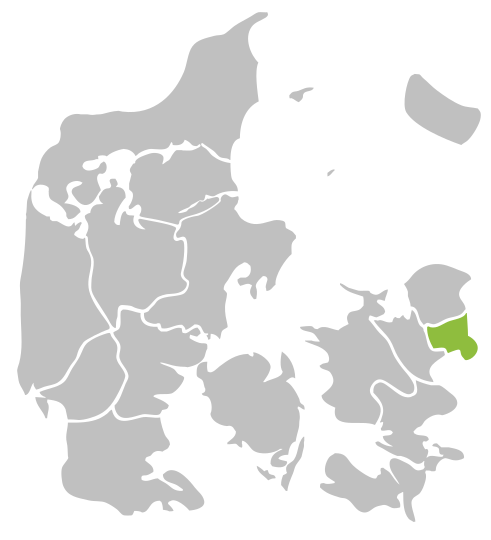
Kgs. Lyngby, Denmark
Apply Before
2026-02-08T22:59:00+00:00
This job posting is collected from company pages and is only shown as short resume. Read entire job ad here: